
Music is a universal language that touches the soul, but understanding it goes beyond just listening.
Whether you’re a beginner learning to read sheet music, a musician trying to perfect your rhythm, or a student preparing for exams, knowing 149+ music notes names and beats is essential. 🎹
In this guide, we’ll break down every note, its corresponding beat, and even provide creative ways to remember them.
By the end, you’ll have a comprehensive understanding of music notation, rhythms, and patterns that will take your music skills to the next level.
Plus, we’ll throw in fun tips and tricks that make learning these notes easy, engaging, and even entertaining! So, whether you’re into classical, pop, or jazz, this guide is your ultimate companion.
✅ Quick Checklist Before Learning Music Notes Names and Beats
Before diving into all the 149+ music notes and beats, make sure you have these basics covered:
- 🎵 Start with the basics – Learn whole, half, quarter, and eighth notes first.
- 📝 Get a visual reference – Use a music sheet or piano diagram.
- ⏱ Practice rhythm slowly – Don’t rush; timing is key!
- 🎧 Listen actively – Try tapping out beats while listening to songs.
- 🖊 Label notes – Writing note names next to sheet music helps retention.
- 🎹 Use an instrument – Practice on piano, guitar, or drum to reinforce learning.
🎶 Classic Notes Names and Their Beats
Here are some fundamental notes every musician should know:
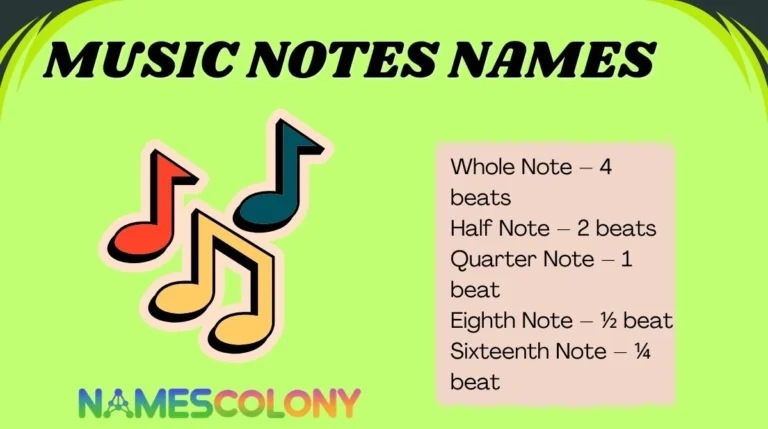
- Whole Note – 4 beats
- Half Note – 2 beats
- Quarter Note – 1 beat
- Eighth Note – ½ beat
- Sixteenth Note – ¼ beat
- Dotted Half Note – 3 beats
- Dotted Quarter Note – 1½ beats
- Dotted Eighth Note – ¾ beat
- Thirty-Second Note – ⅛ beat
- Sixty-Fourth Note – 1/16 beat
- Treble Clef Notes – E, F, G, A, B, C, D
- Bass Clef Notes – G, A, B, C, D, E, F
- Middle C – the central reference point
💡 Which note do you struggle to remember most? Let us know!
🥁 Rhythm and Beat Patterns for Beginners
Mastering rhythm is just as important as memorizing notes:
- Simple 4/4 Beat – Most pop songs use this.
- 3/4 Waltz Beat – Perfect for classical or ballroom music.
- 6/8 Compound Beat – Creates a rolling feel.
- Syncopated Beat – Adds excitement by emphasizing off-beats.
- Polyrhythm – Two rhythms at once for advanced learners.
- Swing Rhythm – Jazz favorite, gives a “groove.”
- Clave Patterns – Essential in Latin music.
- March Beat – Strong, steady 2/4 rhythm.
- Shuffle Rhythm – Blues and rock staple.
- Backbeat Emphasis – Drums emphasize 2nd and 4th beats.
- Funky Groove – Perfect for pop/funk instruments.
- Bossa Nova Beat – Light Brazilian style rhythm.
- Ritardando/Accelerando – Slow down or speed up for drama.
🎵 Which rhythm pattern will you practice today?
🎸 Guitar Notes and Chords Simplified
Here’s a mix of note names and beats specifically for guitar players:
- Open E – 6th string
- Open A – 5th string
- Open D – 4th string
- Open G – 3rd string
- Open B – 2nd string
- Open High E – 1st string
- Power Chord E5 – 2 beats
- Power Chord A5 – 2 beats
- D Major – 1 beat
- G Major – 1 beat
- C Major – 1 beat
- E Minor – 1 beat
- A Minor – 1 beat
🎸 Which chord feels most challenging to you?
🎹 Piano Notes and Finger Placement
For piano enthusiasts, here’s a guide to essential notes:
- Middle C – Finger 1
- D – Finger 2
- E – Finger 3
- F – Finger 4
- G – Finger 5
- A – Finger 1 (right hand)
- B – Finger 2
- C (octave) – Finger 3
- C Major Scale – 1 beat per note
- G Major Scale – 1 beat per note
- F Major Scale – 1 beat per note
- Arpeggios – Split beats
- Chords Practice – 4 beats per chord
🎹 Which scale will you master first this week?
🎷 Saxophone Notes and Key Fingerings
Saxophone players, this one’s for you:
- Low Bb – 2 beats
- B – 2 beats
- C – 1 beat
- D – 1 beat
- E – 1 beat
- F – 1 beat
- G – 1 beat
- High A – ½ beat
- High Bb – ½ beat
- High C – ½ beat
- Low Altissimo – advanced notes
- Arpeggios Practice – split beats
- Jazz Riffs – syncopated beats
🎷 Which sax riff will you try today?
🥁 Drums: Beats and Fills
Drummers, rhythm is your playground:
- Basic Rock Beat – 4/4
- Funk Groove – 16th notes
- Shuffle Beat – swung 8th notes
- Latin Clave – syncopation
- Jazz Swing – triplets
- Double Stroke Roll – fast beats
- Single Stroke Roll – steady beats
- Paradiddle – alternating hands
- Flam – accented note combos
- Drag – ornamented strokes
- Ghost Notes – quiet snare taps
- Fill-in 4 beats – transitions
- Drum Solo – combine patterns
🥁 Which drum pattern excites you most?
🎼 Reading Sheet Music Notes Easily
Here are 13 essential tips for sheet music:
- Treble clef vs Bass clef differences
- Ledger lines – notes above/below staff
- Note duration symbols
- Rest symbols for silence
- Time signature recognition
- Key signature learning
- Accidentals – sharp, flat, natural
- Dynamics – loud/soft marks
- Tempo – beats per minute
- Articulations – staccato, legato
- Repeat signs
- Slurs and ties
- Fingering numbers for piano/guitar
📖 Which sheet music symbol confuses you most?
🎵 Fun Mnemonics for Memorizing Notes
Learning notes can be fun with mnemonics:
- Every Good Boy Deserves Fudge (Treble)
- FACE for spaces
- Good Boys Do Fine Always
- All Cows Eat Grass (Bass)
- Musical Alphabet Song
- Color-coded stickers on keys
- Clap rhythms while reciting names
- Visual flashcards
- Rhythm games
- Apps like Simply Piano or Yousician
- Record and playback
- Write your own songs
- Challenge friends in quizzes
🎵 What’s your favorite way to memorize notes?
🌟 Extra Value Sections
- Research – We gather all note names, rhythms, and beats.
- Categorize – Group by instruments and complexity.
- Simplify – Use easy explanations for beginners.
- Add Visuals – Notes, piano diagrams, and rhythm charts.
- Include Fun Tricks – Mnemonics, apps, and exercises.
- Test Readability – Ensure anyone can understand.
Tips for Making Your Music Stand Out
- 🎤 Practice consistently every day
- 🥁 Learn multiple instruments
- 🎼 Compose your own music
- 🎧 Record and analyze your performance
- 🧠 Understand music theory
- 💡 Experiment with unique rhythms and notes
FAQs
What are the 149+ music notes names and beats?
The 149+ notes include standard whole, half, quarter, eighth, sixteenth notes, dotted variations, ledger line notes, treble and bass clef notes, and instrument-specific variations for piano, guitar, drums, and wind instruments.
How do I memorize all music notes easily?
Use mnemonics, visual aids like piano diagrams, practice daily, clap out rhythms, and engage with music apps.
What is the difference between a beat and a note?
A note is the pitch and duration of a sound, while a beat refers to the timing or rhythm in which the note is played.
Can I learn music notes online for free?
Yes! Platforms like YouTube tutorials, music theory apps, and free PDF sheet music can help beginners.
How many beats are in common note types?
- Whole note: 4 beats
- Half note: 2 beats
- Quarter note: 1 beat
- Eighth note: ½ beat
- Sixteenth note: ¼ beat
Which instrument is easiest for learning music notes?
Piano is often the easiest because notes are visually laid out, but guitar and recorder are also beginner-friendly.
Conclusion
Learning 149+ music notes names and beats doesn’t have to be intimidating! With practice, mnemonics, and interactive exercises, you can master music theory and play your favorite tunes with confidence.
Start small, focus on one section at a time, and gradually build your skills. Remember, every great musician started with the basics! 💪
🎶 Which note or rhythm will you master first? Share your favorite in the comments!

I am Grace Miller, passionate about exploring meaningful and unique names.
I help people discover names that reflect identity, style, and personality.